
Table of Contents
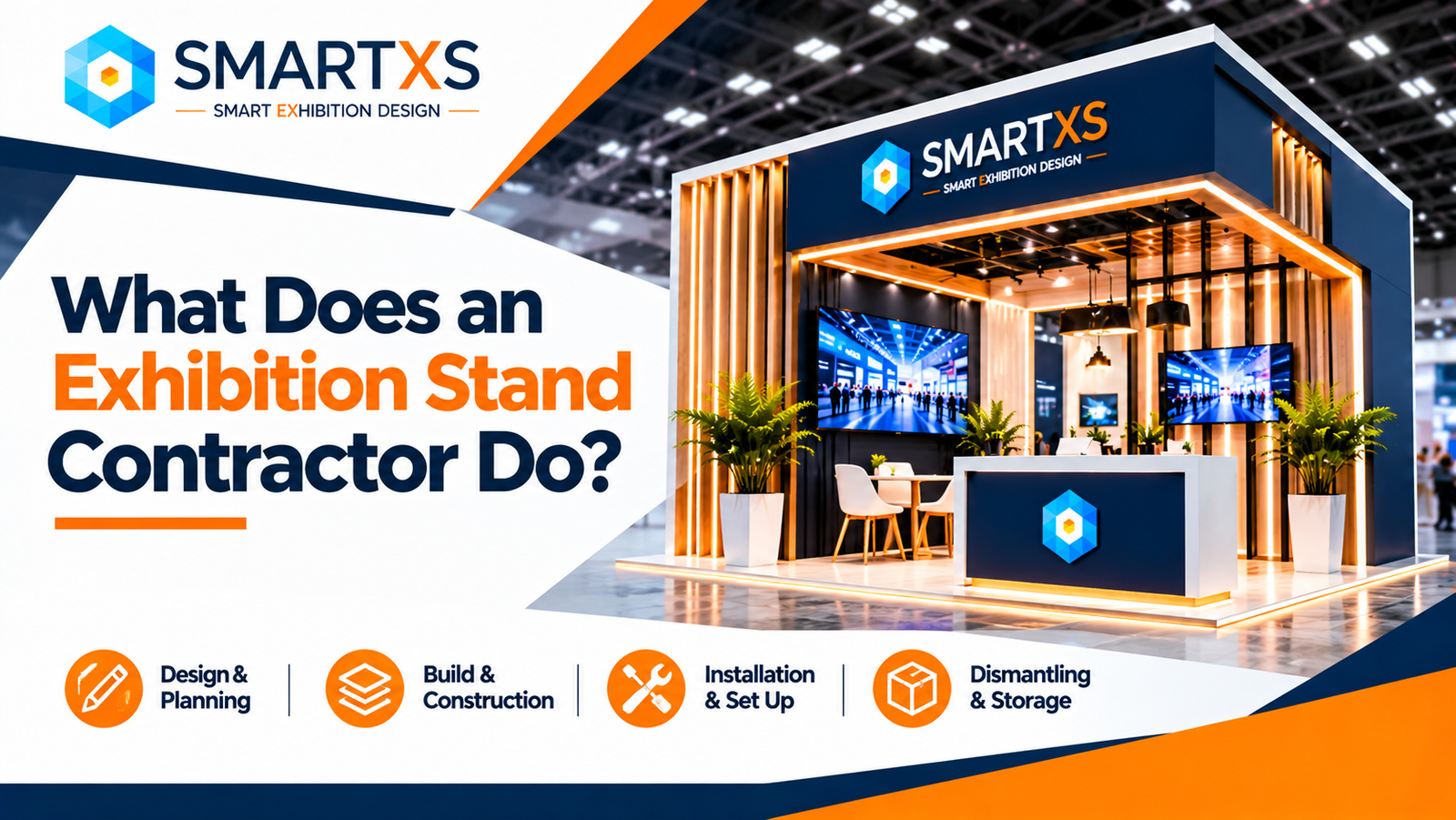
What Does an Exhibition Stand Contractor Do?
Planning an exhibition involves much more than choosing a stand design and arranging a few promotional materials. Behind every professionally built exhibition stand is a coordinated process involving creative design, technical planning, manufacturing, logistics, installation and dismantling.
This is where exhibition stand contractors play an essential role.
An exhibition stand contractor is responsible for turning a company’s exhibition requirements into a physical stand that is suitable for its brand, visitors and chosen venue. Depending on the services agreed, the contractor may oversee everything from the initial briefing and design development to construction, on-site installation and post-event dismantling.
For businesses attending trade shows in the UK, understanding what an exhibition stand contractor does can make exhibition planning significantly easier.
Whether you are preparing for an event at Birmingham’s NEC, ExCeL London or another exhibition venue, working with experienced exhibition stand contractors UK businesses can rely on helps bring the different elements of a project together.
In this guide, we explain the responsibilities of exhibition contractors, how they manage stands from concept to completion, and why choosing a turnkey exhibition partner can simplify the entire process.
What Is an Exhibition Stand Contractor?
An exhibition stand contractor is a specialist company that plans, designs, builds or manages exhibition stands for trade shows, conferences and corporate events.
The exact responsibilities depend on the contractor’s capabilities and the agreement with the exhibitor.
Some contractors concentrate on fabrication and installation. Others provide a complete design-and-build service, coordinating the entire project from the initial creative concept to dismantling after the event.
A full-service contractor may arrange:
- Exhibition stand design and space planning.
- Bespoke, modular or hybrid stand construction.
- Technical drawings and production specifications.
- Exhibition graphics and branding.
- Lighting, furniture and audio-visual equipment.
- Logistics, transport and delivery.
- Venue coordination and installation.
- On-site project supervision.
- Dismantling, storage and potential reuse.
The main objective is to create a safe, functional and visually engaging exhibition environment that supports the exhibitor’s business goals.
What Does an Exhibition Stand Contractor Actually Do?
In simple terms, exhibition stand contractors manage the practical work needed to transform an empty exhibition space into a completed branded stand.
Their responsibilities typically extend across the full project lifecycle.
Project stage | Contractor’s responsibilities |
Initial consultation | Understand the brand, exhibition goals and requirements |
Concept design | Develop the stand layout, visuals and visitor experience |
Technical planning | Prepare specifications and coordinate relevant approvals |
Production | Manufacture structures, graphics and display components |
Logistics | Arrange transport, delivery and equipment handling |
Installation | Assemble the stand and prepare it for the exhibition |
On-site support | Coordinate agreed technical and operational requirements |
Dismantling | Safely remove the stand after the event |
Storage and reuse | Manage reusable components where agreed |
Not every supplier offers every service. Before appointing a contractor, exhibitors should establish which stages are included and who is responsible for the remaining activities.
Let’s explore each stage in more detail.
1. Understanding the Exhibition Brief and Business Objectives
Every successful exhibition stand project begins with understanding what the exhibitor wants to achieve.
Before developing design concepts, a professional exhibition contractor should learn about the company’s brand, products, target audience and event objectives.
What Does the Initial Consultation Cover?
The contractor may ask:
- Which exhibition are you attending?
- What are the stand dimensions and location?
- What products or services will be displayed?
- Who is your target audience?
- Do you need meeting areas or demonstration spaces?
- Will the stand be used at future exhibitions?
- Are there any specific branding or technical requirements?
These questions help the contractor recommend an appropriate design and construction approach.
For example, a business exhibiting industrial equipment may need robust display areas, accessible demonstrations and practical visitor circulation.
A software company may prioritise interactive screens, presentation areas and private meeting spaces.
Although both businesses are attending trade shows, their exhibition requirements are very different.
Turning Objectives Into a Practical Brief
A clear brief helps avoid unnecessary design changes later.
The contractor should understand not only how the stand should look but also how visitors and staff will use it.
This early planning stage forms the foundation of the entire exhibition project.
2. Exhibition Stand Concept Design and Space Planning
Once the brief is established, the next stage involves developing the exhibition stand design.
This is where creativity and functionality must work together.
Exhibition stand design and build specialists consider how the available space can communicate the brand’s message while supporting practical activities throughout the event.
Developing the Initial Concept
Designers may prepare visual concepts showing:
- Stand layout and dimensions.
- Brand colours and visual identity.
- Product demonstration areas.
- Reception and hospitality counters.
- Meeting spaces.
- Lighting and digital displays.
- Visitor entrances and circulation routes.
Three-dimensional visualisations can help exhibitors understand how the completed stand might look before construction begins.
Creating a Better Visitor Experience
An effective exhibition stand should encourage visitors to approach, explore and interact with the business.
The design must therefore consider visibility, accessibility and movement.
An impressive structure is not automatically an effective exhibition stand. If visitors cannot understand the company’s message or comfortably access its displays, the design may not achieve its purpose.
Contractors must balance creativity with practical considerations such as structural requirements, venue restrictions and available installation time.
3. Technical Planning and Venue Coordination
After the initial concept is approved, the project moves into technical planning.
This stage is particularly important for bespoke exhibition stands and more complex installations.
The contractor develops the information required to manufacture the stand and coordinate the construction process.
Preparing Technical Documentation
Depending on the project, technical planning may involve:
- Detailed construction drawings.
- Structural specifications.
- Material selection.
- Electrical and lighting layouts.
- Flooring and accessibility details.
- Equipment installation requirements.
- Relevant safety documentation.
- Organiser and venue submissions.
Exhibition venues and organisers often have specific requirements for stand construction, access and installation.
A capable contractor should identify which documentation is required and coordinate the relevant work.
Why Venue Knowledge Matters
Different exhibitions can have different stand regulations, submission deadlines and operational arrangements.
A contractor must work with the event’s exhibitor manual rather than assume that requirements will be identical at every venue.
The Association of Event Venues eGuide provides industry guidance on safety, operational planning and conduct at UK event venues.
Understanding these requirements early helps reduce complications during the build-up period.
4. Manufacturing and Exhibition Stand Construction
Once the design and technical details are finalised, construction can begin.
This is where exhibition contractors transform approved drawings into physical structures and display components.
Bespoke Exhibition Stand Construction
Bespoke stands are created around a particular design brief.
They may include custom-built counters, display walls, specialist finishes, product areas and distinctive architectural elements.
The contractor coordinates fabrication to ensure the finished components reflect the approved design.
Modular Exhibition Stand Construction
Modular stands use adaptable structural components that can be assembled into different configurations.
They are often suitable for businesses attending multiple exhibitions with varying stand dimensions.
Modular construction can also make it easier to replace graphics or reconfigure the layout for another event.
Hybrid Exhibition Stand Solutions
Hybrid stands combine reusable modular structures with customised features.
This approach can provide flexibility while still allowing a distinctive brand appearance.
Regardless of the construction method, quality control is important.
Contractors should review materials, finishes, component compatibility and practical installation requirements before the stand reaches the exhibition venue.
5. Exhibition Graphics, Branding and Technology
An exhibition stand must clearly communicate who the exhibitor is and what it offers.
Contractors may coordinate the production and installation of branded graphics, signage and visual displays.
Brand Integration
Common branding elements include:
- Company logos and illuminated signage.
- Large-format printed graphics.
- Product information panels.
- Reception desk branding.
- Digital presentations.
- Directional signs.
- Branded meeting environments.
These elements should work together rather than compete for attention.
Audio-Visual and Interactive Features
Many exhibition stands incorporate digital displays and demonstration equipment.
Depending on the project, the contractor may coordinate screens, sound systems, interactive technology and equipment integration.
Careful planning is necessary to position technology effectively and manage cables, power connections and maintenance access.
The aim is to make the technology support the visitor experience rather than distract from it.
6. Exhibition Logistics, Shipping and Delivery
Exhibition logistics is one of the less visible responsibilities of an exhibition stand contractor, but it is essential to successful delivery.
Stand components must arrive at the correct venue, within the appropriate access period and in suitable condition for installation.
What Does Exhibition Logistics Include?
Depending on the agreed scope, contractors may coordinate:
- Packaging and protection of components.
- Transport to the venue.
- Delivery scheduling.
- Vehicle access arrangements.
- Handling and unloading.
- Coordination with venue logistics teams.
- International shipping arrangements where required.
Some exhibitions involve multiple suppliers delivering equipment to the same site.
Effective coordination helps ensure the installation team has the materials it needs when work begins.
International Exhibition Logistics
For businesses exhibiting overseas, logistics can become more complex.
Transport planning may involve international shipping, customs arrangements and coordination with local exhibition teams.
Smart XS lists exhibition shipping and wider project management services within its service offering.
7. On-Site Exhibition Stand Installation
Installation is the stage where all the planning, design and construction come together.
Contractors coordinate the assembly of stand components within the access periods permitted by the exhibition organiser.
What Happens During Installation?
The process may include:
- Checking the allocated exhibition space.
- Unloading and positioning stand components.
- Assembling structural elements.
- Installing flooring, counters and display units.
- Fitting graphics and signage.
- Coordinating electrical and audio-visual equipment.
- Completing finishing work.
- Conducting final checks before handover.
The sequence depends on the stand’s complexity and the venue’s requirements.
Quality Checks Before Handover
Before handing the stand over to the exhibitor, the project team should check the agreed design and functional requirements.
Graphics should be fitted correctly, display areas should be ready for use, and agreed technology should be tested.
Any outstanding work should be identified and resolved through the appropriate project contacts.
Good installation management allows the exhibitor’s team to concentrate on preparing its presentations, products and customer engagement activities.
8. Health, Safety and Compliance Responsibilities
Exhibition stand construction involves equipment, temporary structures, electrical services and people working within busy event environments.
Safety planning must therefore be treated as an essential part of the project.
What Are Contractors Expected to Consider?
Relevant considerations include:
- Safe construction and dismantling methods.
- Competent personnel.
- Appropriate equipment and materials.
- Risk assessments.
- Suitable working arrangements.
- Coordination with other contractors.
- Compliance with applicable venue rules.
The UK’s Health and Safety Executive guidance on selecting event contractors recommends assessing contractors’ competence, experience, resources and ability to work safely.
Understanding Construction Responsibilities
Certain exhibition stand construction activities may fall within the Construction (Design and Management) Regulations 2015.
The applicable duties depend on the nature of the work and the project’s arrangements.
An experienced contractor should understand its responsibilities, coordinate with relevant dutyholders and explain how safety requirements will be managed.
Exhibitors should not assume that appointing a stand contractor automatically removes their own responsibilities.
9. On-Site Support and Exhibition Project Management
The work of an exhibition contractor may continue after installation.
For some projects, on-site support is included to help manage technical issues or operational requirements during the event.
What Can On-Site Support Involve?
Agreed services may include:
- Assistance with display equipment.
- Technical troubleshooting.
- Coordination with venue teams.
- Minor adjustments to stand components.
- Support for exhibition-related operational issues.
These services should be confirmed before the exhibition begins.
Why Project Management Is Important
A project manager acts as a central point of contact between the exhibitor and the various teams involved in delivery.
Without clear coordination, businesses may find themselves communicating separately with designers, construction teams, technology suppliers and logistics providers.
A managed approach can simplify communication and make responsibilities easier to track.
10. Exhibition Stand Dismantling After the Event
When an exhibition finishes, the stand needs to be removed in accordance with the organiser’s dismantling arrangements.
This process requires planning just as installation does.
What Happens During Dismantling?
Depending on the construction method, the contractor may:
- Disconnect and remove display equipment.
- Take down graphics and signage.
- Disassemble structural components.
- Separate reusable materials.
- Package equipment for transport.
- Coordinate removal from the venue.
- Arrange delivery or storage.
Careful dismantling can help protect components intended for future use.
Why Dismantling Should Be Planned Early
The removal process should not be treated as an afterthought.
Contractors need to consider access arrangements, equipment handling, safety requirements and the available dismantling period.
A clear plan helps the exhibitor understand when the stand will be removed and what happens to its materials afterwards.
11. Storage, Maintenance and Stand Reuse
For businesses attending several trade shows, the end of one exhibition may be the starting point for the next.
Some exhibition contractors offer storage and reuse services for stand components.
Benefits of Reusable Exhibition Systems
A reusable stand can provide:
- Greater consistency between events.
- Flexibility for different exhibition layouts.
- The ability to update graphics.
- Reduced need for entirely new structural components.
- More predictable planning for future exhibitions.
These benefits depend on the stand’s design, materials and condition.
Planning for Future Exhibitions
Discuss future events during the initial briefing stage.
If the business expects to exhibit at multiple venues, the contractor may recommend modular or hybrid construction.
Smart XS also describes equipment storage services as part of its exhibition offering.
A long-term approach can help businesses maintain consistent branding across their exhibition programme.
12. Why Work With a Turnkey Exhibition Stand Contractor?
A turnkey exhibition contractor provides a coordinated solution across multiple stages of exhibition delivery.
Instead of appointing separate businesses for design, fabrication, logistics and installation, the exhibitor works with a partner responsible for managing the agreed services.
One Main Point of Contact
One of the clearest benefits is simpler communication.
Rather than sending updates to several unrelated suppliers, the exhibitor can communicate with a designated project manager.
This can make approval processes and progress updates easier to manage.
Better Coordination Between Design and Construction
When designers and construction specialists work within a coordinated process, technical considerations can be addressed during design development.
This may reduce the risk of discovering practical problems after a concept has been approved.
Clearer Project Responsibilities
A turnkey approach can make it easier to understand who is responsible for each stage.
However, the contract should still clearly identify the included services, any subcontracted activities and the responsibilities retained by the exhibitor.
More Consistent Delivery
Coordinated project management helps connect design decisions with production schedules, transport arrangements and installation requirements.
For busy marketing teams managing several events, this can be especially valuable.
Ultimately, a turnkey partner allows the exhibitor to spend less time coordinating individual suppliers and more time preparing for customer engagement.
13. Exhibition Stand Contractors vs Designers vs Builders
These terms are often used interchangeably, but they describe different responsibilities.
Exhibition Stand Designers
Designers concentrate on the stand’s creative concept, branding, layout and visitor experience.
They translate the exhibitor’s objectives into a practical visual proposal.
Exhibition Stand Builders
Builders focus on the physical construction, fabrication and installation of stand components.
They turn approved designs into completed structures.
Exhibition Stand Contractors
Contractors may manage design, construction and delivery, depending on their specialisation.
A full-service contractor can coordinate all three areas, along with logistics and related project services.
The distinction matters because not every company advertising exhibition services provides a complete turnkey package.
14. Exhibition Stand Contractors in Birmingham and London
Businesses exhibiting across the UK often need contractors familiar with major exhibition venues and their operational requirements.
Exhibition Stand Contractors in Birmingham
Birmingham is a major destination for UK trade exhibitions, particularly through the NEC.
Exhibitors attending NEC events need to consider stand design, organiser requirements, installation scheduling and access arrangements.
Businesses planning an event in the region can explore Smart XS’s information on exhibition stand contractors in Birmingham.
Exhibition Stand Contractors in London
London hosts exhibitions across technology, healthcare, finance, retail and other industries.
Venues such as ExCeL London provide opportunities for businesses to connect with national and international audiences.
Exhibitors need to ensure their contractor understands the practical requirements of the selected event.
Discover more about exhibition stand contractors in London and the services available through Smart XS.
15. How Smart XS Supports Exhibition Projects
Smart XS is a UK-based exhibition and event design-and-build specialist offering a range of services for businesses attending trade shows and corporate events.
Based in Redditch, Worcestershire, the company works with clients requiring professional exhibition environments in the UK and internationally.
Exhibition Design and Build
Smart XS provides exhibition design and build services that bring together creative concepts and practical construction requirements.
The company emphasises understanding a client’s brand, products, market and objectives before developing an exhibition solution.
Full Project Management
Smart XS offers project management services covering exhibition planning and coordination.
Its published services also include fabrication, graphics, audio-visual requirements, shipping and storage.
Support for Different Exhibition Requirements
Businesses may need bespoke design features, adaptable structures or support with multiple exhibitions.
An experienced project team can help assess these requirements and develop an approach suited to the event.
To discuss a project, visit the Smart XS contact page.
Frequently Asked Questions
What is the main responsibility of an exhibition stand contractor?
The main responsibility is to deliver the agreed exhibition stand requirements. This may involve design, technical planning, construction, logistics, installation and dismantling. Full-service contractors also coordinate multiple suppliers and project stages.
Do exhibition stand contractors design stands?
Many do. Some contractors employ or work with exhibition designers, while others focus only on construction. It is important to confirm whether design services are included.
What does a turnkey exhibition contractor provide?
A turnkey contractor coordinates multiple services through a managed process, potentially including design, production, transport, installation and dismantling. The exact package should be agreed before the project begins.
Who installs an exhibition stand?
Installation is normally carried out by the appointed stand-building or installation team. The contractor may supervise this work and coordinate with the venue and other suppliers.
Do exhibition contractors handle health and safety documentation?
Contractors may prepare or coordinate relevant construction documentation, including risk assessments and method statements, depending on their responsibilities. Exhibitors should confirm the division of duties and the event’s specific requirements.
Can a contractor manage multiple exhibitions?
Yes. Some companies support clients attending several events, including different UK venues and international exhibitions. Reusable stand systems, storage and logistics planning may be particularly useful.
What happens to an exhibition stand after the event?
The stand is dismantled and removed. Depending on the agreement, components may be transported, stored, reused, recycled or otherwise handled according to the agreed arrangements.
Why choose a full-service exhibition contractor?
A full-service contractor can simplify communication, connect design with construction and coordinate delivery through one managed process. This is particularly useful for businesses with complex stand requirements or limited internal event-management resources.
Conclusion: From Initial Brief to Final Dismantling
Exhibition stand contractors are responsible for much more than building display structures.
Their work can begin with an initial consultation and continue through design, technical planning, fabrication, transport, installation, event support and dismantling.
For businesses attending trade shows, professional project coordination is essential to creating an exhibition environment that supports brand visibility, visitor interaction and commercial objectives.
Working with one experienced turnkey exhibition partner can make these stages easier to manage and provide a clearer route from initial concept to completed exhibition stand.
If your business is planning an upcoming exhibition, Smart XS can help you explore suitable design, build and project management solutions.
Ready to discuss your next exhibition project? Contact Smart XS to share your requirements and explore the available options.