
Table of Contents
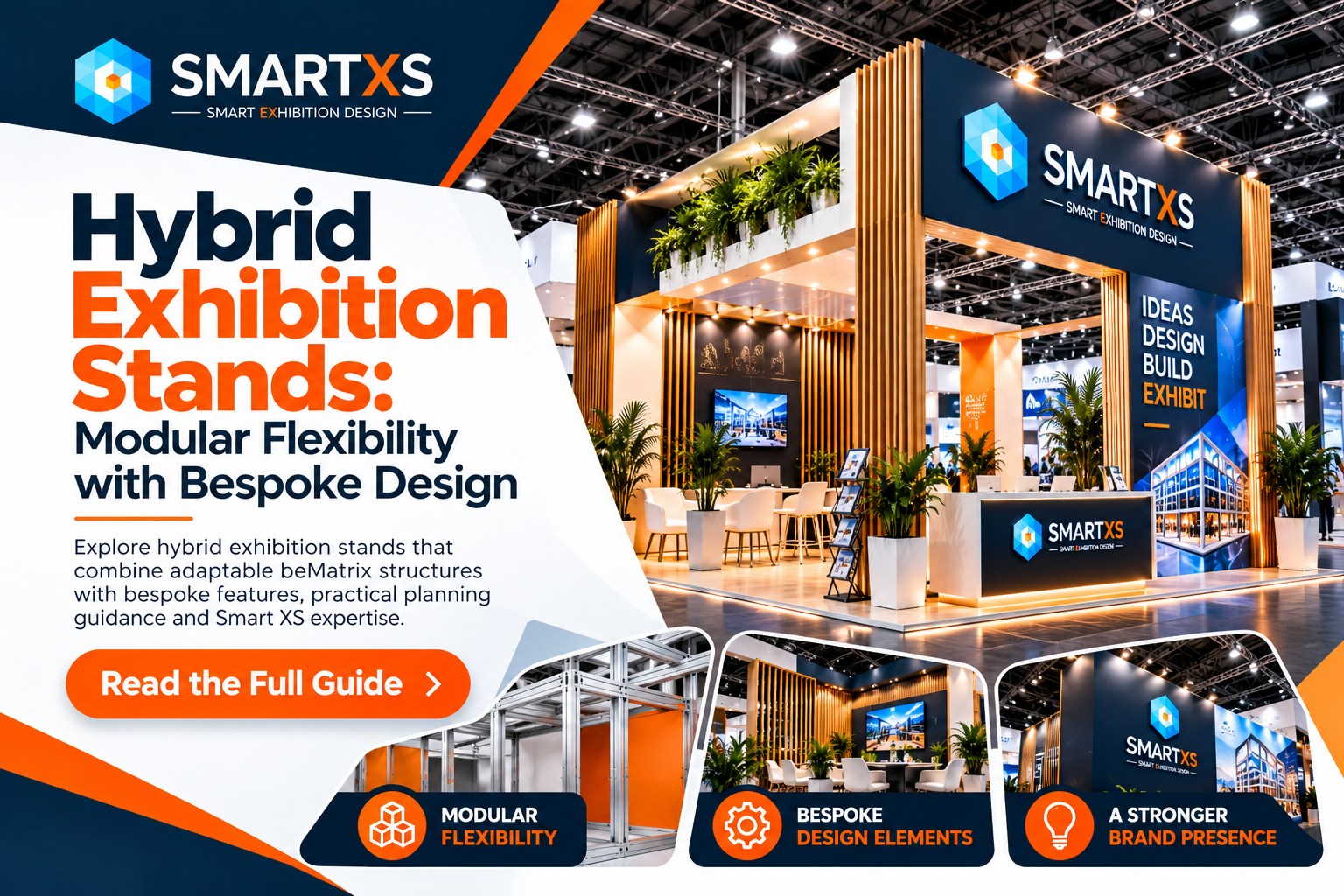
Hybrid Exhibition Stands: Modular Flexibility with Bespoke Design
Hybrid exhibition stands require more than an attractive design or a convenient service description. UK exhibitors need a practical plan that connects the right people, equipment and decisions to a successful event. This guide explains the steps in a way that marketing managers and event teams can apply to real exhibition programmes.
Understanding the hybrid exhibition stand approach
A hybrid exhibition stand combines a repeatable structural framework with individually designed features. The framework supplies a dependable starting point while the custom components communicate the exhibitor’s identity. This is different from treating modular design as a standard booth with a new graphic attached. The creative brief should determine where individual features genuinely improve the visitor experience.
Consider the stand as a set of connected zones rather than a single object. A welcome area, a demonstration point and a meeting space have different purposes. Modular frames can define those zones, while carefully chosen finishes, displays and furniture make them feel like one branded environment.
Practical questions to ask
Before moving to the next stage, ask who owns the decision, what information is missing and what could prevent the planned activity from working. These questions turn a broad recommendation into an action that a marketing manager or event organiser can use. They also reveal whether the stand design, the technical team and the exhibition schedule are aligned.
When a modular framework is useful
A modular framework is particularly relevant when a business attends several events with changing floor plans. The same core structural components may support more than one configuration, provided the new arrangement is checked for compatibility and safety. A familiar structural system can also help the project team understand how graphics and accessories fit together.
Flexibility must be planned rather than assumed. A stand that works with two open sides might not communicate effectively when placed between neighbouring exhibitors. The design team should revisit sightlines, entry points, wall positions and technical services whenever the configuration changes.
How to document the decision
Keep a short record of the agreed approach, the relevant drawing or inventory reference and the person who confirmed it. If the decision affects another supplier, share the updated instruction directly rather than assuming it will be passed on. Clear records matter when teams are working at different locations or preparing for more than one event.
How beMatrix can support bespoke exhibition design
Smart XS describes its rental offering as a customisable range of hybrid stands using the beMatrix system with bespoke custom elements. This is a specific capability stated on the company’s services page, not a claim that every exhibition structure uses that system. The approach makes sense when an exhibitor wants a recognisable architectural presence with adaptable underlying components.
A successful brief identifies which elements should remain modular and which should be designed for the brand. A reception counter may need a distinctive shape. A product display may require specialist mounting. These features should be resolved alongside the frame layout so the final environment is coherent and buildable.
Explore completed exhibition environments in the Smart XS project portfolio.
Smart XS provides hybrid exhibition stand solutions as part of its exhibition services for UK and international events.
For related guidance on exhibition stand storage and reuse, see our dedicated article covering that stage of the exhibition process.
For related guidance on international exhibition shipping, see our dedicated article covering that stage of the exhibition process.
For related guidance on exhibition project management checklist, see our dedicated article covering that stage of the exhibition process.
What successful execution looks like
The test is whether the exhibition team can use the result without additional explanation or last minute improvisation. Visitors should be able to navigate the environment, staff should know how equipment operates and contractors should have the information needed for safe delivery. Review the outcome against the original brief rather than appearance alone.
Writing a useful design brief
A useful exhibition brief describes the event, the audience, the main business message and the activities expected on the stand. Include the venue, stand dimensions, open sides, anticipated visitor flow and equipment requirements. Explain what visitors should understand after a short interaction and what the exhibition team needs to achieve.
Avoid beginning with a list of decorative preferences alone. Brand colours and reference images are helpful, but they do not explain the operational purpose of the space. The design team needs to know whether demonstrations, meetings, presentations or informal conversations will dominate the event.
Practical questions to ask
Before moving to the next stage, ask who owns the decision, what information is missing and what could prevent the planned activity from working. These questions turn a broad recommendation into an action that a marketing manager or event organiser can use. They also reveal whether the stand design, the technical team and the exhibition schedule are aligned.
For related services, explore Smart XS exhibition services and review how the company supports stand delivery across different event requirements.
Planning entrances and visitor circulation
The first design decision is often where people will enter. A large counter across an open frontage can discourage visitors from stepping inside, while poorly positioned furniture can create congestion. Look at the aisles around the stand and identify the approaches from which visitors are most likely to arrive.
A stand with several open sides needs visual cues from more than one direction. Keep important messages visible and provide clear routes between demonstrations and meeting areas. Accessibility should be reviewed throughout the layout process rather than treated as a late adjustment.
How to document the decision
Keep a short record of the agreed approach, the relevant drawing or inventory reference and the person who confirmed it. If the decision affects another supplier, share the updated instruction directly rather than assuming it will be passed on. Clear records matter when teams are working at different locations or preparing for more than one event.
Making graphics communicate quickly
Exhibition visitors rarely read every panel. The main graphic should communicate the brand and its proposition without requiring a lengthy explanation. Supporting messages can introduce applications, sectors or specific product benefits. Strong hierarchy matters more than filling every surface with copy.
Designers should test legibility from realistic viewing distances and consider what may be hidden by people or furniture. Graphic materials and fixing details must suit the chosen system. Campaign messages may change between events, so consider how replaceable graphic areas will be managed.
What successful execution looks like
The test is whether the exhibition team can use the result without additional explanation or last minute improvisation. Visitors should be able to navigate the environment, staff should know how equipment operates and contractors should have the information needed for safe delivery. Review the outcome against the original brief rather than appearance alone.
Using lighting and screens with purpose
Lighting should make the stand comfortable, guide attention and support product presentation. A screen can explain a complex process or demonstrate a product, but it needs an editorial purpose. Repeating a generic brand film on every display is not necessarily the most useful experience for visitors.
Plan screen orientation, viewing distance, sound, power and cable routes before construction drawings are finalised. A demonstration screen may need a clear area for a small audience. Lighting positions should avoid unwanted glare on displays and important graphic surfaces.
Practical questions to ask
Before moving to the next stage, ask who owns the decision, what information is missing and what could prevent the planned activity from working. These questions turn a broad recommendation into an action that a marketing manager or event organiser can use. They also reveal whether the stand design, the technical team and the exhibition schedule are aligned.
Designing practical demonstration zones
Demonstration areas work best when equipment, presenters and visitors have enough room. Consider how long a typical demonstration lasts and whether a group will gather. If a product needs power, network access or a stable platform, those requirements should be recorded early.
Keep the demonstration visible without blocking the main entrance. Where specialist equipment is involved, confirm handling and safety requirements with the relevant technical team. A hybrid stand should make the product easier to understand, not force the product into an unsuitable architectural layout.
How to document the decision
Keep a short record of the agreed approach, the relevant drawing or inventory reference and the person who confirmed it. If the decision affects another supplier, share the updated instruction directly rather than assuming it will be passed on. Clear records matter when teams are working at different locations or preparing for more than one event.
Creating meeting spaces that people will use
A meeting area can be informal or enclosed depending on the type of conversation expected. An open table may suit short introductions, while detailed technical discussions may require more privacy. Think about noise, seating, visibility and movement around the meeting area.
Do not assume a larger meeting space is always better. The stand needs to balance private conversations with a welcoming public presence. Where enclosed rooms are planned, ventilation, emergency access and organiser regulations should be reviewed by the project team.
What successful execution looks like
The test is whether the exhibition team can use the result without additional explanation or last minute improvisation. Visitors should be able to navigate the environment, staff should know how equipment operates and contractors should have the information needed for safe delivery. Review the outcome against the original brief rather than appearance alone.
Integrating bespoke furniture and display features
Bespoke counters, plinths and product fixtures can give a modular stand an individual character. Each feature should earn its place by improving the visitor journey or supporting the brand message. Decorative forms without a practical role may consume valuable space and complicate installation.
Check dimensions, stability, finish durability and access for maintenance. If the component will travel to more than one event, consider how it will be protected and handled. A custom feature that is difficult to pack or repair may undermine the intended adaptability of the wider stand.
Practical questions to ask
Before moving to the next stage, ask who owns the decision, what information is missing and what could prevent the planned activity from working. These questions turn a broad recommendation into an action that a marketing manager or event organiser can use. They also reveal whether the stand design, the technical team and the exhibition schedule are aligned.
The Smart XS project portfolio provides examples of completed exhibition environments. These are project examples rather than promises that every new brief has the same technical scope.
Reviewing venue technical requirements
Every exhibition has its own organiser guidance and technical submission process. Height limits, construction rules, electrical arrangements and permitted materials may vary. A previous design approval does not automatically apply to the next venue.
Obtain the event manual early and assign responsibility for technical submissions. Structural elements and unusual features may need additional review. Treat compliance as part of design development so creative decisions can be adjusted before the installation period begins.
How to document the decision
Keep a short record of the agreed approach, the relevant drawing or inventory reference and the person who confirmed it. If the decision affects another supplier, share the updated instruction directly rather than assuming it will be passed on. Clear records matter when teams are working at different locations or preparing for more than one event.
Coordinating production and installation
The design becomes real through fabrication, graphic production, technical integration and installation. Those activities need a shared set of approved drawings and clear responsibilities. Late changes to one element can affect adjacent components, delivery sequencing and on site access.
A practical installation plan identifies which work must happen first and when specialist contractors are needed. Leave time for inspection, lighting checks and final presentation. The stand should be ready for the exhibition team to use, not simply assembled.
What successful execution looks like
The test is whether the exhibition team can use the result without additional explanation or last minute improvisation. Visitors should be able to navigate the environment, staff should know how equipment operates and contractors should have the information needed for safe delivery. Review the outcome against the original brief rather than appearance alone.
Planning for several UK exhibitions
Businesses exhibiting in Birmingham, London, Manchester or elsewhere in the UK may encounter different stand footprints and organiser requirements. Establish which brand elements should stay consistent across events and which can adapt. This helps create recognition without forcing every venue into the same layout.
Keep an accurate record of component dimensions and previous configurations. Before committing to a new arrangement, confirm that the available components support the proposed design. Venue access, transport and installation constraints also need separate assessment for each event.
Practical questions to ask
Before moving to the next stage, ask who owns the decision, what information is missing and what could prevent the planned activity from working. These questions turn a broad recommendation into an action that a marketing manager or event organiser can use. They also reveal whether the stand design, the technical team and the exhibition schedule are aligned.
Thinking about reuse and storage from the beginning
Reusable components require deliberate handling. Identify what can be retained, what needs protective packaging and which graphics are specific to a single campaign. A clear inventory helps designers understand what is available for a future event.
Smart XS offers insured storage for reusable exhibition equipment. Its services page also discusses recycling selected materials. Those statements support a practical reuse conversation, but the environmental performance of any individual stand depends on its actual materials, transport and handling.
How to document the decision
Keep a short record of the agreed approach, the relevant drawing or inventory reference and the person who confirmed it. If the decision affects another supplier, share the updated instruction directly rather than assuming it will be passed on. Clear records matter when teams are working at different locations or preparing for more than one event.
Connecting the stand to wider project management
A hybrid structure is only one part of exhibition delivery. Graphics, AV, venue services, transport, installation and dismantling all affect the final result. The design team should coordinate these dependencies through a clear project owner.
Smart XS provides exhibition design and build alongside project management, shipping and storage. For businesses planning more than one event, that combined service scope is relevant because future configurations and equipment handling can be considered while the first stand is developed.
What successful execution looks like
The test is whether the exhibition team can use the result without additional explanation or last minute improvisation. Visitors should be able to navigate the environment, staff should know how equipment operates and contractors should have the information needed for safe delivery. Review the outcome against the original brief rather than appearance alone.
What to review before approving a design
Review the proposed stand from the visitor’s perspective and the installation team’s perspective. Check that the main message is legible, entrances are inviting, demonstrations have enough room and staff can work comfortably. Ask whether any feature has been added solely for visual effect.
Then examine the technical drawings and operational requirements. Confirm equipment positions, graphic specifications, venue restrictions and dismantling arrangements. A visually impressive rendering is useful, but it is not a substitute for a fully coordinated design.
Practical questions to ask
Before moving to the next stage, ask who owns the decision, what information is missing and what could prevent the planned activity from working. These questions turn a broad recommendation into an action that a marketing manager or event organiser can use. They also reveal whether the stand design, the technical team and the exhibition schedule are aligned.
A practical Smart XS next step
Smart XS has delivered exhibition environments for a range of brands and publishes project examples on its website. These examples can help prospective exhibitors understand the scale and variety of its work, although a new brief should always be evaluated on its own requirements.
To explore a hybrid stand, share the event name, stand dimensions, visitor activities, brand materials and anticipated future exhibitions with the Smart XS team. Ask how modular components and bespoke elements could work together for your specific objectives.
How to document the decision
Keep a short record of the agreed approach, the relevant drawing or inventory reference and the person who confirmed it. If the decision affects another supplier, share the updated instruction directly rather than assuming it will be passed on. Clear records matter when teams are working at different locations or preparing for more than one event.
Related Smart XS guides
This topic connects with Smart XS exhibition services, including design, project management, international shipping and equipment storage. The following planned guides address adjacent questions without repeating this article.
For the related operational topic, read Exhibition Project Management Checklist: From Brief to Dismantling once that article has been published.
For the related operational topic, read International Exhibition Shipping: A Practical Guide for UK Exhibitors once that article has been published.
For the related operational topic, read Exhibition Stand Storage and Reuse: Preparing for Future Events once that article has been published.
Frequently asked questions
What makes a hybrid exhibition stand different?
It combines a modular framework with bespoke elements designed for the brand. The balance depends on the event brief and the technical capabilities of the system.
Can the same hybrid stand work at several UK venues?
Selected components may be reconfigured, but every venue and layout needs its own technical and operational review.
Does Smart XS use beMatrix?
Smart XS states that its hybridised rental stands use the beMatrix system with bespoke custom elements.
Can a hybrid stand include private meeting space?
Yes, where the available footprint, design and venue rules allow it. The layout should consider access, comfort and circulation.
Discuss your next exhibition with Smart XS
For a discussion focused on hybrid exhibition stands, share the event details, stand requirements and any relevant equipment information with Smart XS. Its team can consider the brief alongside the company’s published exhibition design, project management, shipping and storage services. Visit Smart XS contact to begin the conversation.